

Let Us Settle the Debate Over the 2013 Tom Cruise Sci-Fi Film "Oblivion" Once and For All
Grab your popcorn, handkerchiefs, and reading glasses.

“The past is never dead. It’s not even past. All of us labor in webs spun long before we were born, webs of heredity and environment, of desire and consequence, of history and eternity.”
—William Faulkner
There’s a debate which has not been raging for the last 13 years over whether or not the 2013 Tom Cruise sci-fi flick Oblivion is any good. Let’s settle that once and for all, right now!
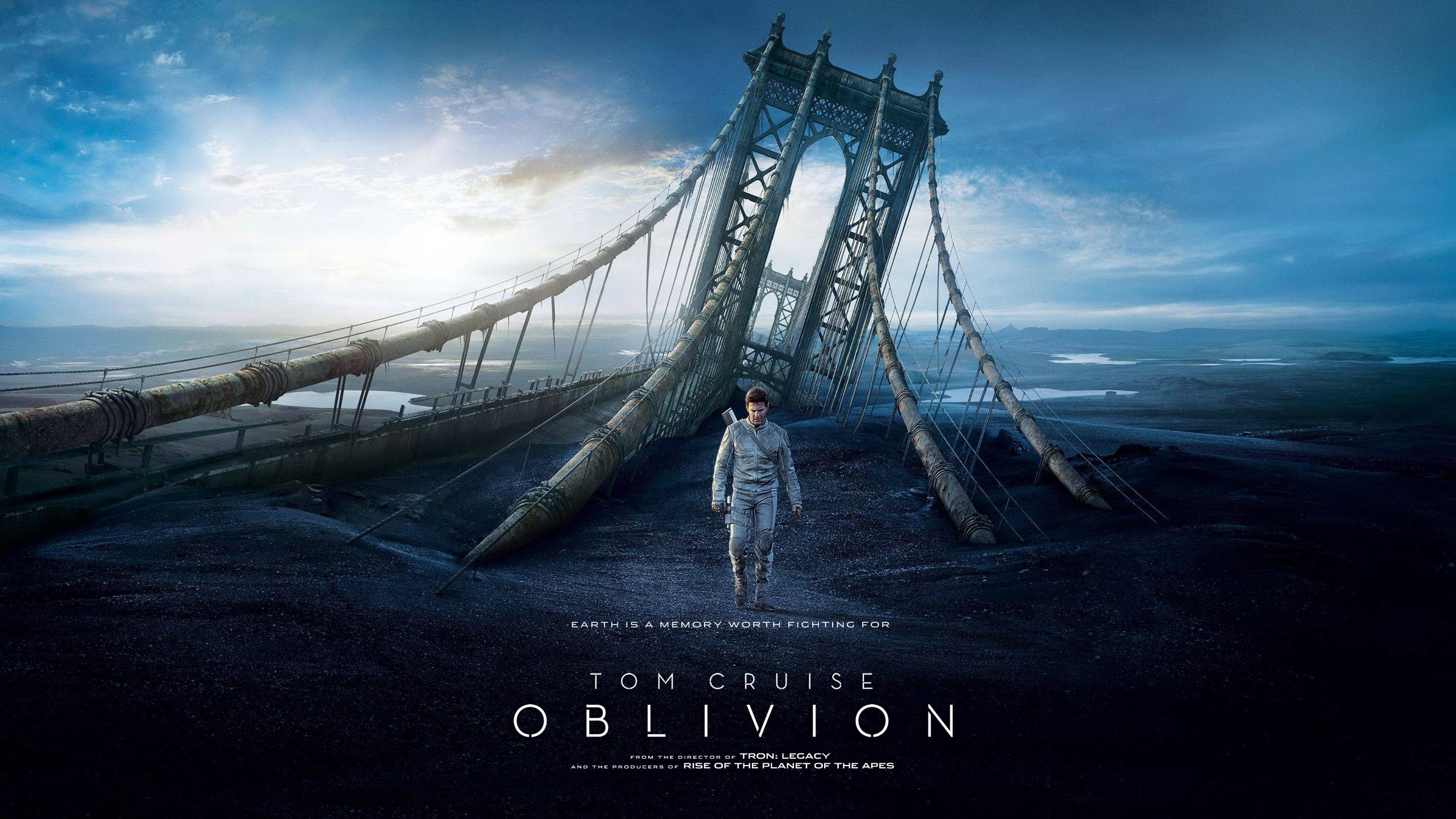
There are essentially three schools of thought around this film:
Some say it is not good.
Other’s say it punches above it’s own weight and manages—despite its flaws and shortcomings—to do something from a human storytelling perspective that puts it in league with the likes of Interstellar, Arrival, or 2001 A Space Odyssey.
The remaining majority of the world’s population has never seen Oblivion and/or confuse it with the Tom Cruise/Emily Blunt sci-fi action blockbuster Edge of Tomorrow which released the following year.
As you likely guessed, this essay is coming straight at you, and brashly, from the second school of thought. If you are in Camp 1: brace yourself. If you are in Camp 3: This thing is gonna be full of spoilers for a movie you probably still won’t ever care enough about to stream for $3.99 on Amazon Prime (and I’m not even getting paid for that).
When this movie came out it seemed like a no-brainer for me as someone who enjoys pretty much everything Tom Cruise puts out. What I wasn’t expecting in 2013 when I first saw the movie was for it to move me so deeply, and haunt me for the last decade+. As one reviewer said,
“Tom Cruise is in this movie. But it’s not a Tom Cruise movie. There is action and sci-fi in this movie. But it’s not an action sci-fi movie. Remove any pre-conceived notions or expectations before watching this film, and you will thoroughly enjoy it.”
That’s because this movie, despite its flaws, punches above its own weight and delivers something deeply human that lingers well after the credits roll. Which is what proper cinema is supposed to do, right?
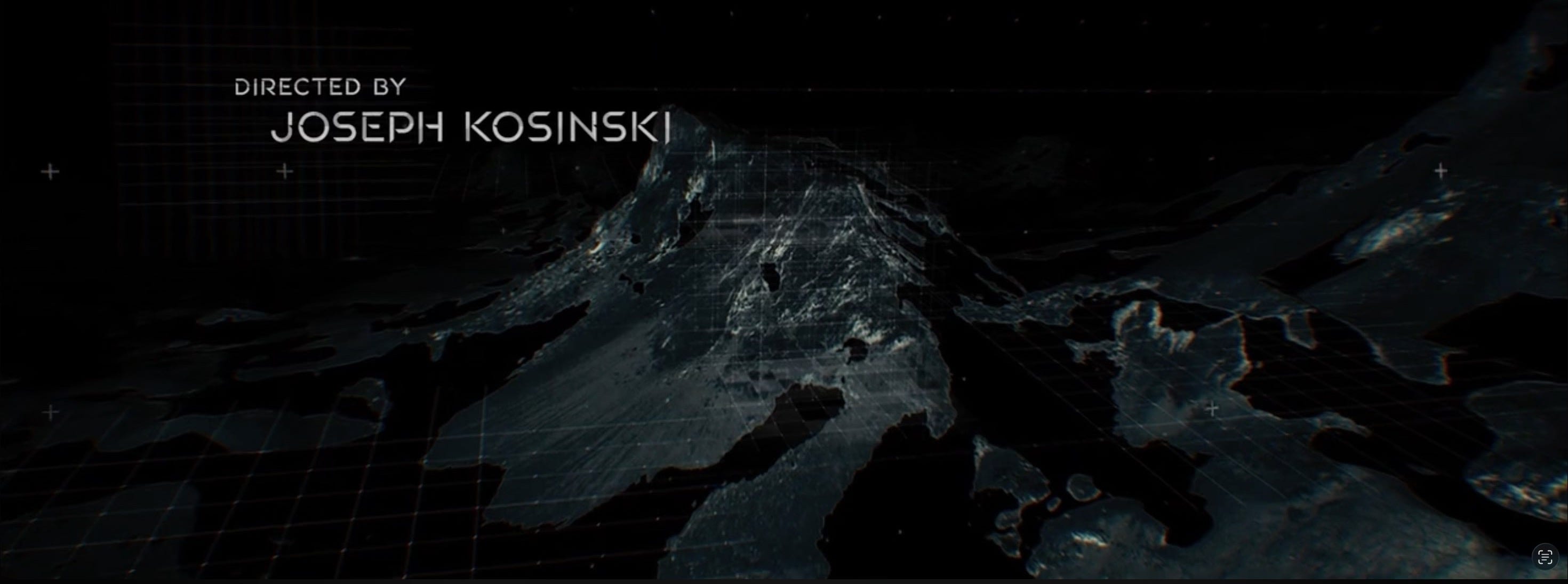
If Oblivion is anything as a film it is a visually stunning masterpiece (but I’m arguing it’s far more than eye candy!) Just look at these post-apocalyptic visuals, and if you look closely you’ll see portions of the Big Apple and other U.S. landmarks buried in what director Joseph Kosinski called “beautiful desolation”:


* * * * *
Setting the Stage
Oblivion opens with a killer soundtrack by M83 that just won’t quit and a dream sequence that feels like a memory of Jack (played by Tom Cruise) and a woman (Olga Kurylenko) at the top of the Empire State Building, circa early 2010’s. In this intimate memory, they share a moment together looking out over New York City. Jack’s narration opens the film and sets the stage:
“I know you, but we’ve never met. I’m with you, but I don’t know your name. I know I’m dreaming, but it feels like more than that. It feels like a memory.
How can that be?”
But the year, Jack tells us upon waking, is 2077. We’re introduced to Jack and his colleague/love interest Vika (Andrea Riseborough) who find themselves living in a futuristic Neo-minimalist tower-in-the-clouds above what used to be New York City after a mass extinction event brought on 60 years earlier. First came the unexplained natural disasters all cross the globe and, wouldn’t you know it, on the heels of all of that mayhem came the aliens, Jack informs us. Humans fought back but had to use the nukes. We won the battle against the aliens but lost the planet in the process.
Jack is now the last remaining drone maintenance tech (aka Tech #49) stationed with Vika (Jack’s eyes in the sky) and together they function as the final “mop up crew” on Earth, five years after the mandatory memory wipe. They’re counting down the last few days until they can finish the objectives given to them by Mission Control which is stationed on the massive spaceship, called The Tet, just off-planet which will soon whisk away Jack, Vika, and the remnant of humanity to colonize Titan, Saturn’s largest moon. Those who are left on The Tet are having to say goodbye to our celestial home, but we have a way forward.
Mission Control gives them the same two objectives each day:
To ensure the massive HydroRigs can harvest enough water for Titan and
For Jack to make sure security drones can protect the HydroRigs from the small number of remaining aliens who are scattered in defeat (called Scavengers/Scavs).
Each day Sally from Mission Control asks, “Are you an effective team?” to which Vika always responds in the affirmative. While Jack and Vika might be an effective team, they’re somewhat of an odd couple. Vika is buttoned up and is guided by following protocol, always seeking to be effective and compliant for Sally at Mission Control. Jack, on the other hand, is something of an anomaly.
On a routine maintenance run on the ground to find a downed drone, Jack stumbles into a massive sinkhole which turns out to be the subterranean ruins of the pre-war New York Public Library. On his way out after escaping a few Scavs, he notices a book called The Lays of Ancient Rome, an epic poem by Thomas Babington Macaulay. He sneaks it back to the tower and opens to a passage from “Horatius” which reads:
Then out spake brave Horatius,
     the Captain of the Gate:
‘To every man upon this earth
     Death cometh soon or late.
And how can man die better
     Than facing fearful odds,
For the ashes of his fathers,
     And the temples of his Gods.'
In secret, he puzzles over the words. At first he doesn’t fully understand them, but he feels them almost like déjà vu. In time, he will not only understand but enact them.
Oblivion makes its first narrative turn the following day as Jack finishes his surveillance and then goes off-COMS to sneak away to a secret place hidden in a gorgeous valley; a hidden paradise with a waterfall surrounded by the only trees for hundreds of miles. It’s here that Jack has built himself a secluded open-air cabin, and it strikes us that this is his real home—away from Vika and the tower and Mission Control. Jack’s rustic Airbnb is complete with wind turbine electricity, a record player, shelves carefully laden with pre-war knick-knacks, and a small collection of books he’s found: precious items that remind him of a better past which he struggles to fully remember.
In a distinctly Christian imagination this is a new Garden of Eden. He cultivates precious plant life in the shade of a mountain and ladles lake water to his lips by hand; he shoots basketballs into an old hoop and is content to watch fish swim in the sunlight of his private lake. As Jack marvels over fish, I was reminded of Cormac McCarthy’s final lines from The Road:
Once there were brook trouts in the streams in the mountains…They smelled of moss in your hand. Polished and muscular and torsional. On their backs were vermiculate patterns that were maps of the world in its becoming. Maps and mazes. Of a thing which could not be put back. Not be made right again. In the deep glens where they lived all things were older than man and they hummed of mystery.
You feel his sense of wonder, rest, and humanity in this place much like Adam and Eve must have felt. Jack’s Garden is good. But it is not good that the Man is alone. And Jack feels like he knows he’s got a good thing here, but something’s missing.
And that’s the moment when everything changes. Suddenly, in the sky, a mysterious space shuttle crash lands nearby, interrupting his idyllic respite and life as he knows it.
[SPOILER ALERT]
Jack races to the crash site and finds, to his dismay, a pre-war NASA crew still in their hyper-sleep pods. He watches in horror as the drones he routinely repairs are autonomously killing the crew members in their sleep, which he knows is against their protocol. He manages to save one crew member in the last pod but, to his shock, it is the same woman from his dream of the Empire State Building.
From here on out, everything Jack believes begins to unravel.
Throughout the rest of the film, we follow his journey to the truth: that the mass-extinction event 60 years earlier was actually caused by an alien, artificial super-intelligence which made its interstellar journey over to Earth to harvest our ocean water as fuel. Unfortunately for us, it was the bad guys who showed up in the Tet, that massive off-planet spaceship structure (like in Independence Day, “welcome to earth!”) and they promptly destroyed our beautiful moon which then catastrophically shotgunned massive meteorological debris onto all of us down below while simultaneously causing tsunamis hundreds of feet high in all directions, followed by resulting earthquakes. Taken altogether, most of the globe was engulfed in swift destruction and the vast majority of life on Earth was quickly snuffed out as the A.I. Invader set to work stealing approximately 5.83 quadrillion gallons of our ocean water.1
In 2013, ‘artificial intelligence’ was merely a fun idea for a futuristic movie villain, something we could worry about in the future. Fast forward only 13 years and artificial intelligence is quite literally everywhere you go and is quite literally stealing potable water from people at an untenable rate to the point where some citizens don’t even have enough water to flush their toilets! Seems like Oblivion was ahead of its time.
Bummer.
But there’s still a love story to be had!
* * * * *
Bringing It Home
Here’s why I love this movie:
At the heart of this film is a love story, but…it’s complicated. And as a love story, Oblivion is about what it means to be human. And while that’s not the most original angle in storytelling, I think Oblivion does it beautifully and, doggonit, poignantly. What grips me in this story, specifically, is how it reveals the way that love and memory are linked, and about how memory is one of the most powerful forces inherent in the human experience. The film is about how each of us has a deep longing for home that never fully goes away and never truly resolves. Oblivion gives us yet another cinematic glimpse of the extreme lengths humans will go to be reunited with and save the ones they love. It reminds us how love and sacrifice are human qualities which make no real logical sense to machines, who only value efficiency and survival.
Love and Memory
Jack’s voice opens the film with that line: “I know I’m dreaming, but it feels like more than that. It feels like a memory. How can that be?”
In the rising action Jack asks Vika, “Do you have any memories?” to which she flatly replies, “Our job is not to remember anything.” But Jack has a snippet of a memory: the woman he once took to the Empire State Building before the War. When he discovers her after the crash landing he brings her to the tower with Vika and finds out that this mysterious newcomer is actually his wife from before the War! Turns out she has been in hyper-sleep orbit for 60 years!
Turns out he does know her and they have met and he learns her name is Julia. Through a series of unfolding events Jack makes his way into the forbidden “Radiation Zone” which Mission Control has told him to fear and avoid. And what Jack finds there is not radiation but something far more terrifying: everything he’s been led to believe about himself and reality is a lie. What Jack finds in the so-called “Radiation Zone” is another drone maintenance tech (Tech #52) who looks and is dressed exactly like Jack, who does exactly what Jack does, whose name is also Jack (Jack52), and who is just as shocked and terrified to see him. And here is where Oblivion dares to take the theme of love and memory to its deepest: Jack49 discovers that he and his partner Vika were the first contact with the Aliens and were taken aboard the Tet at the onset of the Alien Invasion and subsequently cloned thousands and thousands of times!
The Jack we’ve been following, Jack49, is just a clone. Vika is a clone. And there are at least 50something clones of Jack and Vika on the ground, oblivious that they are clones, oblivious to the fact that other clones like them are also unknowingly working for the alien invaders. They have unknowingly been cloned and memory wiped and repurposed to achieve the Alien’s goals.
But Jack49 remembers Julia. Jack49—and every other Jack clone—are facsimiles of the original Jacks’ features. But the love the original Jack (JackZero) had for this one person reaches across whatever gulf it is to be a copy of a human being. Oblivion shows us what it means to have human memory and wonders what it would be like for a human being to love another human being not only through time and space but across the aberration of being a copy of the original. Where Interstellar asserts that “Love is the one thing we’re capable of perceiving that transcends dimensions of time and space,” Oblivion gives us a story which believes that love transcends time, space, and ontology.
Oblivion brings into conversation the traditional definitions of identity, soul, and personhood with other cloning narratives which explore the fear that a clone is just a thing, an artifact detached ontologically from the original. So Oblivion falls within the tradition of films like The Sixth Day, which explore how clones inherit the memories and consciousness of the original. In the same way, Oblivion questions if an identical body with the same memories is the same being. How can Jack49 remember and love Julia when Jack49 never experienced what the original Jack experienced?
The answer, I would argue, is that Oblivion gives us is that human love is the ‘Deeper Magic,’ to borrow from fantasy writer C.S. Lewis, which transcends the ‘Deep Magic’ of science and artificial intelligence. What are humans that they could be conquered, cloned, and have their memories cleaned out and yet still love someone as if they were the original? Human love is the deeper magic that transcends time, space, and the very fabric of what it means to exist.
In a scene in which Julia and Jack49 share in the Garden, they put on a record and Julia looks at this copy of her husband and says, “You always loved this song.” Jack49 replies, “I’m not him. I know I’m not, but I’ve loved you for as long as I can remember.” To which she responds, “Those memories are yours, Jack. They’re ours. They ARE you.” Love and memory are mingled across the chasm between the original and the clone. Jack49 is not merely an artifact of JackZero. He shares those memories because he is Jack. In Oblivion, a human is capable of being, loving, and remembering because they are human. We are not mere animals and we are not machines. We are human beings.
As one of my good friends2 reads the film, the barren landscape becomes something of a physiological landscape. He says when you watch Oblivion you see Jack49 traverse the geography of memory, loss, and longing. The land is sparse, the other characters flat and underdeveloped because this is Jack49’s consciousness that navigates fading memories and “types” of people, rather than real, fully developed people. But the sense of longing is palpable.
Home and Longing
A typical storyline in futuristic sci-fi revolves around leaving the planet for greener pastures, but this film is in the tradition of Disney’s masterpiece, Wall-E, about the goodness of earth and the importance of stewarding a home here and not an escape to somewhere else, contra Interstellar. Humans belong on earth with each other.
In the rising action of the film, Jack49 concedes, “Despite all that’s happened, earth is still my home.” He doesn’t want to leave on the Tet for one of Saturn’s moons. He wants to stay in his hidden glade and listen to Springsteen. Before everything is revealed and his life is turned upside down he contemplates leaving earth for good and says aloud, “I’m gonna miss this place. Would’ve been great.” Home is here. But he is also overwhelmed with a sense of longing for the home he should have had before the aliens came and earth was lost.
Isn’t that longing a human longing that each of us feels? This world as it is now isn’t the world it once was and should be. That echo of longing for home touches each of us. Lewis articulates this well in Till We Have Faces, “The sweetest thing in all my life has been the longing — to find the place where all the beauty came from — my country, the place where I ought to have been born. Do you think it all meant nothing, all the longing? The longing for Home? For indeed it now feels like going, but like going back.” The longing for Home doesn’t meaning nothing. It’s actually everything.
Despite the odds, Jack49 has that longing that each of us experience, if we listen to that still small voice, if we notice the pangs we feel when we consider how broken the world and its systems are. The longing for home, both a planet restored and a person we love, is intuitive for each of us.
Sometimes the home we long for is the person we love. I love this, I feel this.
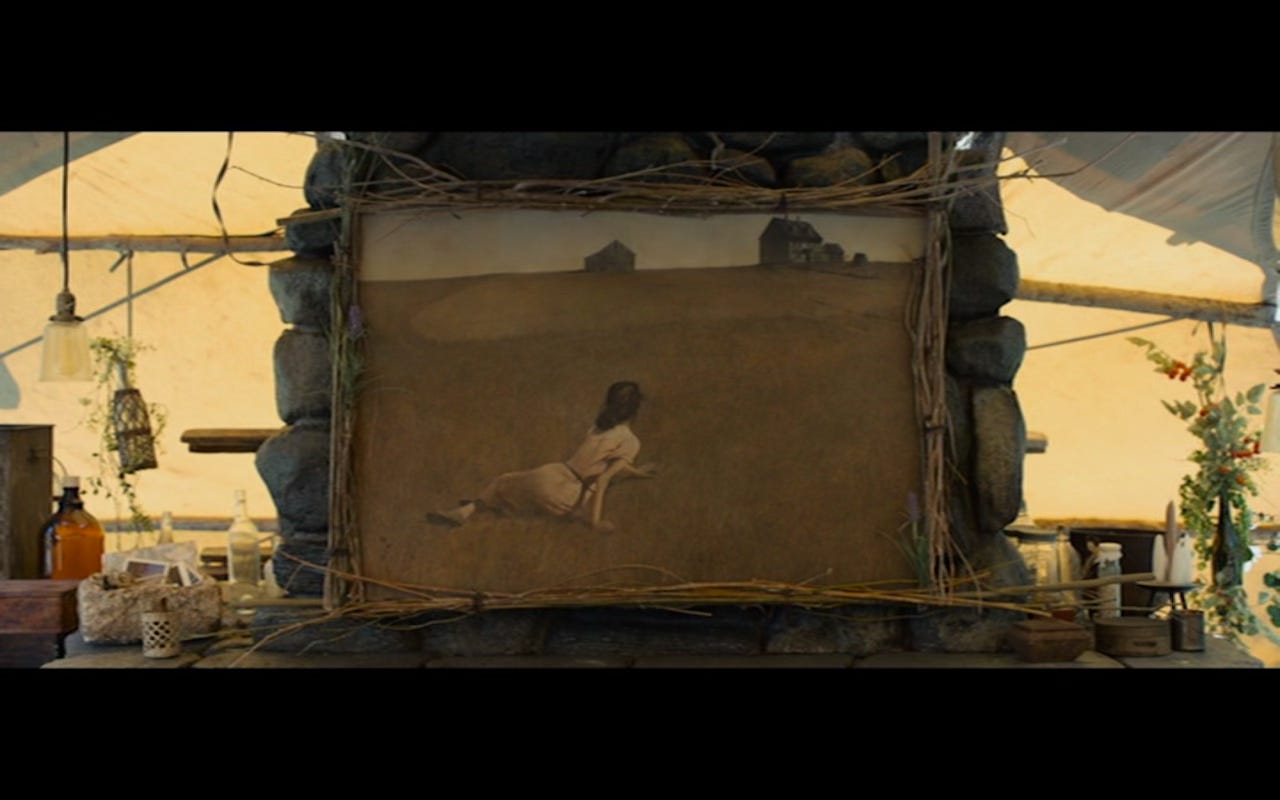
Near the climax of the film, as Jack49 is preparing to sacrifice himself in a fool’s errand to defeat the artificial super-intelligence and the Tet, he stumbles across an original painting that the remaining humans have found and preserved. It’s a famous piece by American painter Andrew Wyeth called, “Christina’s World.”
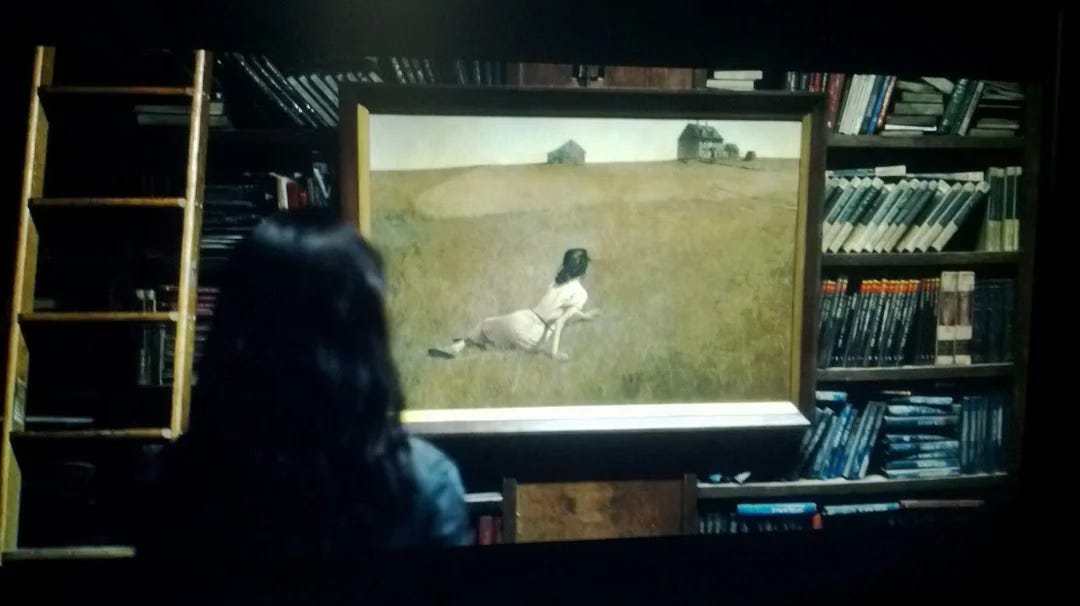
For a moment Jack49 and Julia stare at this painting contemplating the fearful task before them. The story behind the painting from Wyeth, is that his neighbor, Christina, had a degenerative muscular disorder (believed to be Charcot-Marie-Tooth disease) that paralyzed her lower body. Wyeth was inspired by watching her crawl across a field, determined to capture her feat of resilience and “extraordinary conquest of a life which most people would consider hopeless”. Jack and Julia stare at this painting in a moment pregnant with tension.
Julia says “it reminds me of home.”
Like Christina, the remaining humans, specifically Jack & Julia, are earth’s last hope. They, too, are crawling their way back home. To a world without alien invaders and a world where they can finally be reunited. But it is going to cost them everything. They’re clinging to each other and to this good earth much the same way Christina digs her fingers into the earth in the painting:
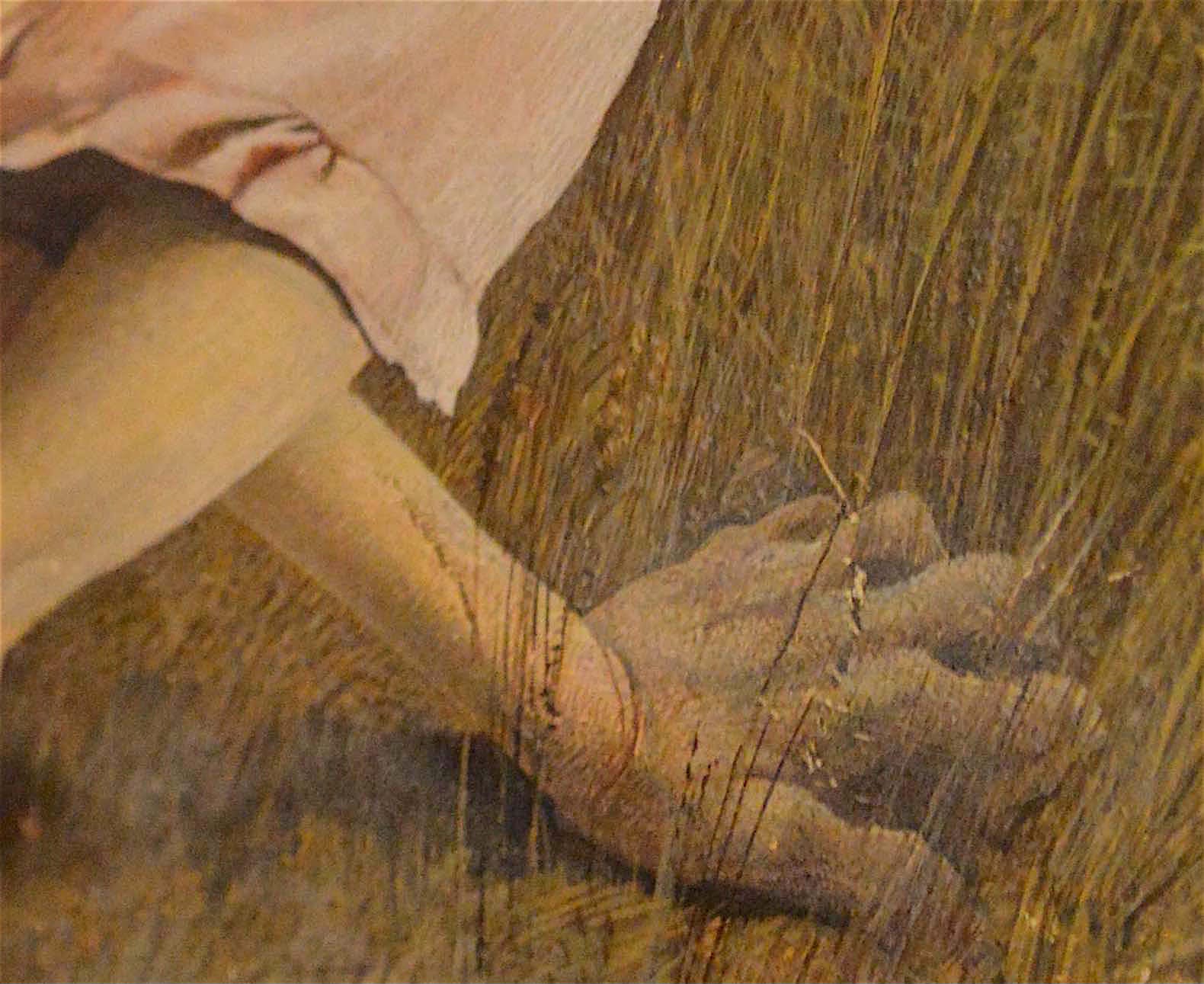
Jack makes peace with who he is: the thousandth-something copy of a man who loved a woman. After ‘Plan A’ to defeat The Tet fails, he realizes that only by sacrificing himself can he save Julia and the others. He remembers the line’s of Macaulay’s poem of Horatius, but now he understands:
To every man upon this earth
     Death cometh soon or late.
And how can man die better
     Than facing fearful odds,
For the ashes of his fathers,
     And the temples of his Gods.
“How can a man die better than facing fearful odds, for the ashes of his fathers, and the temples of his Gods?” Jack49 isn’t merely a facsimile, he’s a man. He is Jack. And he steps into his humanity most wondrously by facing fearful odds and sacrificing himself for the one he loves and those who will come after. He knows he can transcend being just a clone by stepping into the very human experience of self-sacrifice. Machines can’t do that. Machines don’t know what it means to have suffered loss or lay down their life for another. Jack is fully human in and through the cruciformity of his self-sacrifice.
Do you feel a little less human these days? Die to yourself in all of the mundane moments of life, for the sake of others. You’ll find true humanity in that place.
* * * * *
The final moment of the film sees Julia working in the Garden like Eve with her 3 year old child about as many years after Jack49’s successful suicide mission which destroyed the Tet and saved humanity. Jack52 (remember him from earlier?) stumbles upon the hidden Garden valley and finds Julia and the child living in Jack49’s old homestead. Jack52 also knows Julia. He, too, has dreamt of her for years.
In the closing lines of the film, Jack52 and Julia lock eyes for the first time and his voice can be heard,
I wonder if I come to you at night, in dreams. In the day, as memories. If we have souls, they are made of the love we share, undimmed by time, unbound by death.
That’s the heart of this oft-forgotten, oft-misunderstood 2013 sci-fi flick. If we have souls (and we do), they are made of the love we share, undimmed by time, unbound by death. Our love and longing experienced as memories span the chasm of time and death and, ultimately, bring us home.
I did the math based on numbers provided in the script, ok?
Layne!
I loved that movie.
I have not seen it, but now I want to see it. Thank you for this recommendation